
Amla berry
Posted by Emily on Apr 2nd 2026
Amla is that.
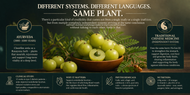
In Ayurvedic medicine (traditional Indian holistic healing), which has been developing and refining its plant knowledge for somewhere between 3,000 and 5,000 years - amla holds a specific and fairly elevated status. It's classified as a Rasayana herb. That category is reserved for plants considered to nourish and rejuvenate at a deep level - not plants that address a single symptom or condition, but plants that the tradition considered foundational to long-term vitality. Amla is one of the most prominent herbs in that category.
In Traditional Chinese Medicine, developed entirely independently across a different geography and culture, the same berry - known there as Yu Gan Zi - was used to strengthen the stomach, support digestion, cool internal heat, and generate body fluids. TCM categorized it among herbs traditionally used to clear inflammation and support the body against infectious conditions.
Different frameworks. Different languages. Different continents. Same plant.
That kind of independent convergence is one of the more compelling signals in herbal medicine - and modern research has started to give it some context.
A 12-week clinical study in type 2 diabetic patients found that amla significantly improved endothelial function, reduced oxidative stress biomarkers, and improved lipid profiles - performing comparably to atorvastatin on some markers.
Here is why that matters: Atorvastatin is one of the most prescribed drugs in the world - a statin, used specifically to manage cardiovascular risk markers. The fact that a food performed in the same range on some of those measures isn't a minor footnote. It's the kind of result that makes researchers pay attention.
And endothelial function is worth understanding if you're not familiar with it. Your endothelium is the thin layer of cells lining every blood vessel in your body - it regulates blood flow, controls inflammation, and is involved in how well your cardiovascular system actually functions day to day. When it's working well you don't think about it. When it's not, it's one of the earliest indicators of cardiovascular stress - often showing up long before anything more serious does.
The phytochemical profile gives some indication of why. Amla contains gallic acid, ellagic acid, emblicanin A and B, quercetin, and rutin - a dense and varied set of polyphenolic compounds that each carry their own biological activity. And then there's the vitamin C: 100 grams of amla contains roughly the equivalent of 20 oranges. Not as the highest C source in Real C - camu holds that title - but as a genuinely substantial whole-food source with an entirely different supporting cast of compounds around it.
One detail that stuck with me when I was researching this: in Ayurveda, amla is said to contain five of the six recognised tastes - sour, sweet, pungent, bitter, and astringent. That might sound like a food curiosity, but in Ayurvedic theory, and even in western herbalism, the presence of multiple tastes in a single food is an indication of breadth of action. The system's way of saying: this one does a lot.
Modern phytochemistry is, slowly, catching up to that assessment.